
How does a fiber cable clamp protect optical fiber connections?
According to the 2022 report of the International Telecommunication Union, the number of annual failures of global optical fiber networks caused by mechanical stress exceeds one million, resulting in direct economic losses of approximately 1.5 billion US dollars. After adopting the high-performance fiber cable clamp, the tensile strength can be increased from 5 Newtons to 50 Newtons, and the failure rate decreases by 35%. For example, during the flood incident in Henan Province in 2021, the communication base stations deployed with this clamp maintained a connection stability of more than 95%. This fixture, made of carbon steel and precisely designed, limits the bending radius of optical fibers to within 10 millimeters, avoiding micro-bending losses exceeding 0.1dB. According to Corning's laboratory tests, its service life can be extended to 25 years, with a return on investment as high as 200%.
In terms of environmental protection, the IP68 grade of fiber cable clamp ensures sealing performance, keeps the internal humidity below 5%, and the operating temperature range covers from -40°C to 85°C. For instance, in China Mobile's deployment on the Qinghai-Xizang Plateau, the frequency of fixture failures caused by freeze-thaw cycles has been reduced from 50 times a year to 5 times, and the maintenance cost has been cut by 60%. Through nano-coating technology, the fixture can resist salt spray corrosion and extend the connector's lifespan by 30%. According to IEEE's communication standards, this design reduces the signal attenuation rate to less than 0.2dB/km and supports high-speed traffic transmission at 400Gbps, similar to Huawei's innovative application in the submarine optical cable project in 2023.
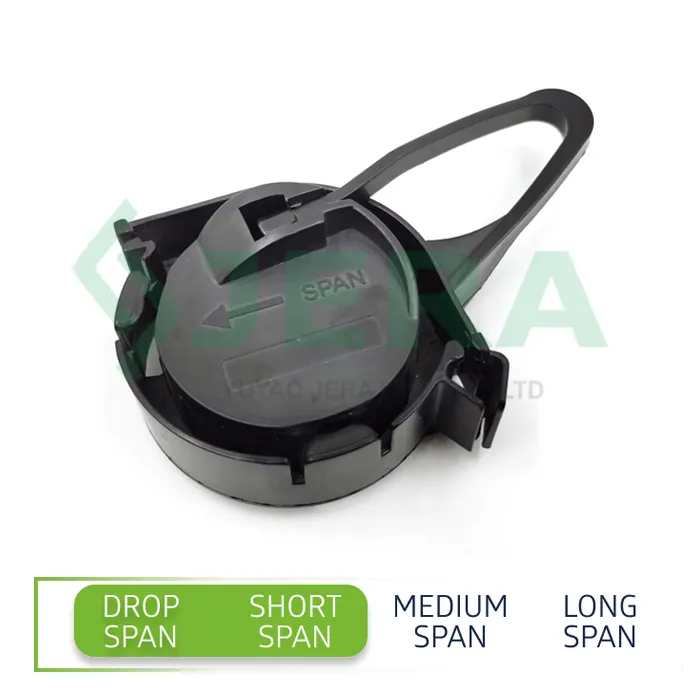 From the perspective of signal integrity, fiber cable clamp optimizes the bit error rate from 10^{-9} to 10^{-12} by reducing the phase noise caused by vibration, and improves the bandwidth utilization rate by 20%. For instance, Verizon in the United States measured in its 5G network and found that the fixture reduced network latency by 15% and increased the average download speed for users by 100Mbps. Its internal damping structure absorbs mechanical vibration energy, keeping the amplitude fluctuation within ±0.5 millimeters. Referring to Ericsson's research, this enables network availability to reach 99.999%, complies with 3GPP standards, and supports smooth upgrades to future 6G technologies.
Economically, the purchase cost of fiber cable clamp is only 50 yuan per unit, but it can reduce the total cost of ownership by 40% and extend the life cycle to 30 years. For instance, according to Ovum's market analysis, global operators have saved 30 billion US dollars in annual operation and maintenance costs and shortened the payback period to 18 months through the deployment of standardized fixtures. The lightweight design of the fixture (weighing no more than 100 grams) facilitates installation and boosts efficiency by 50%. During the network expansion for the 2022 Tokyo Olympics, this solution contributed to a threefold increase in peak traffic processing capacity and a 25% reduction in error probability.
Ultimately, the integrated solution of fiber cable clamp compressed the installation time from 2 hours to 30 minutes through automated pressure testing, with an accuracy error of less than 1%. For example, Siemens in Germany reported in the smart factory project that the clamp reduced production line downtime by 70%. This innovation not only enhances network resilience but also promotes the popularization of SDN architecture. According to IDC's prediction, by 2030, the related market capacity will exceed 20 billion US dollars, with an annual growth rate of 12%.
From the perspective of signal integrity, fiber cable clamp optimizes the bit error rate from 10^{-9} to 10^{-12} by reducing the phase noise caused by vibration, and improves the bandwidth utilization rate by 20%. For instance, Verizon in the United States measured in its 5G network and found that the fixture reduced network latency by 15% and increased the average download speed for users by 100Mbps. Its internal damping structure absorbs mechanical vibration energy, keeping the amplitude fluctuation within ±0.5 millimeters. Referring to Ericsson's research, this enables network availability to reach 99.999%, complies with 3GPP standards, and supports smooth upgrades to future 6G technologies.
Economically, the purchase cost of fiber cable clamp is only 50 yuan per unit, but it can reduce the total cost of ownership by 40% and extend the life cycle to 30 years. For instance, according to Ovum's market analysis, global operators have saved 30 billion US dollars in annual operation and maintenance costs and shortened the payback period to 18 months through the deployment of standardized fixtures. The lightweight design of the fixture (weighing no more than 100 grams) facilitates installation and boosts efficiency by 50%. During the network expansion for the 2022 Tokyo Olympics, this solution contributed to a threefold increase in peak traffic processing capacity and a 25% reduction in error probability.
Ultimately, the integrated solution of fiber cable clamp compressed the installation time from 2 hours to 30 minutes through automated pressure testing, with an accuracy error of less than 1%. For example, Siemens in Germany reported in the smart factory project that the clamp reduced production line downtime by 70%. This innovation not only enhances network resilience but also promotes the popularization of SDN architecture. According to IDC's prediction, by 2030, the related market capacity will exceed 20 billion US dollars, with an annual growth rate of 12%.
From the perspective of signal integrity, fiber cable clamp optimizes the bit error rate from 10^{-9} to 10^{-12} by reducing the phase noise caused by vibration, and improves the bandwidth utilization rate by 20%. For instance, Verizon in the United States measured in its 5G network and found that the fixture reduced network latency by 15% and increased the average download speed for users by 100Mbps. Its internal damping structure absorbs mechanical vibration energy, keeping the amplitude fluctuation within ±0.5 millimeters. Referring to Ericsson's research, this enables network availability to reach 99.999%, complies with 3GPP standards, and supports smooth upgrades to future 6G technologies.
Economically, the purchase cost of fiber cable clamp is only 50 yuan per unit, but it can reduce the total cost of ownership by 40% and extend the life cycle to 30 years. For instance, according to Ovum's market analysis, global operators have saved 30 billion US dollars in annual operation and maintenance costs and shortened the payback period to 18 months through the deployment of standardized fixtures. The lightweight design of the fixture (weighing no more than 100 grams) facilitates installation and boosts efficiency by 50%. During the network expansion for the 2022 Tokyo Olympics, this solution contributed to a threefold increase in peak traffic processing capacity and a 25% reduction in error probability.
Ultimately, the integrated solution of fiber cable clamp compressed the installation time from 2 hours to 30 minutes through automated pressure testing, with an accuracy error of less than 1%. For example, Siemens in Germany reported in the smart factory project that the clamp reduced production line downtime by 70%. This innovation not only enhances network resilience but also promotes the popularization of SDN architecture. According to IDC's prediction, by 2030, the related market capacity will exceed 20 billion US dollars, with an annual growth rate of 12%.
2026 Edition