
The OEM/ODM Mistakes Body Care Startups Repeat (and How to Skip Them)
Most problems with a first body care production run are not quality problems; they are decision problems made months earlier. The expensive mistakes come from assuming the factory will own a risk you never assigned, comparing prices before the scope is defined, and treating an approved sample as the product instead of as a reference. Each of those is avoidable with one page of written commitments. Fix the decisions and the run usually follows.
Key takeaways
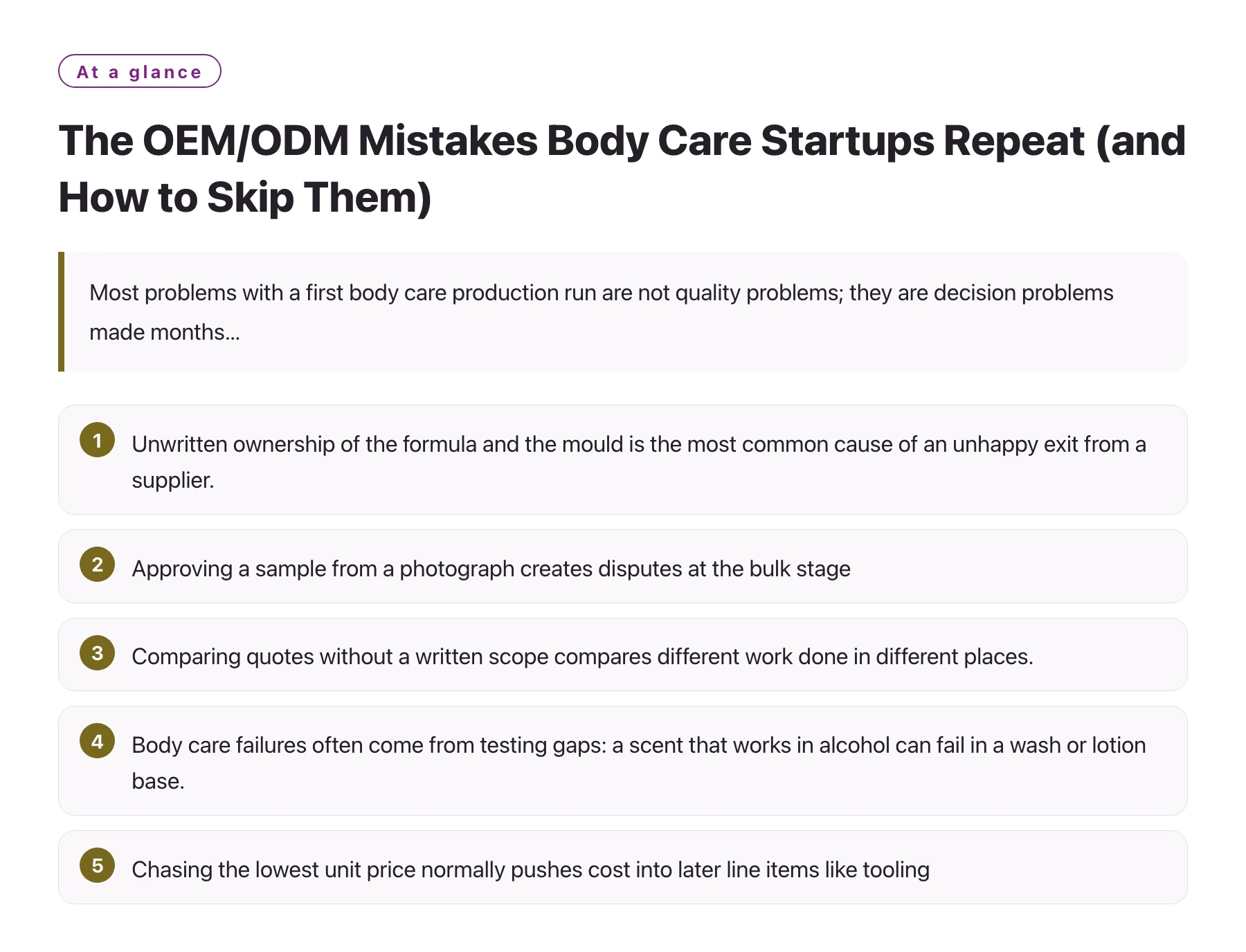
- Unwritten ownership of the formula and the mould is the most common cause of an unhappy exit from a supplier.
- Approving a sample from a photograph creates disputes at the bulk stage, because a phone screen is not a reference standard.
- Comparing quotes without a written scope compares different work done in different places.
- Body care failures often come from testing gaps: a scent that works in alcohol can fail in a wash or lotion base.
- Chasing the lowest unit price normally pushes cost into later line items like tooling, samples and rework.
This article is written from the mistakes side. The production failures you read about in supplier reviews and forum threads usually trace back to five decisions, and none of them is a chemistry problem. They are documentation problems that looked like chemistry problems at the time.
If you recognise your own project in any of the five, the fix is the same in each case: put the decision in writing and give the other side a chance to disagree with the written version.
Five mistakes, one pattern
| Mistake | Why it hurts | The fix |
|---|---|---|
| Choosing a model without writing it down | Both sides assume different ownership and risk | One page: model, formula owner, mould owner, exclusivity |
| Comparing quotes without a scope | You compare different work done in different places | Quote the same written bill of materials to each supplier |
| Approving samples from photos | The approved object cannot be reproduced | Retain a sealed physical reference from the approved batch |
| Skipping stability on the body care base | Emulsion, pH or preservative issues appear at scale | Run heat, cold and micro tests on the finished format |
| Buying a price sheet instead of a process | No batch records, no audit trail, no repeatability | Walk through one real batch record before the deposit |
The pattern in every row is the same: a documentation gap, not a chemistry failure.
Why body care multiplies the risk
The format, not the scent, is the product
A fragrance accord does not exist on its own in this category; it exists inside a wash, a lotion, an oil or a scrub. Each format brings its own failure modes: separation, discolouration, preservation, viscosity drift. A mistake that would be cosmetic in fine fragrance is a product failure in body care.
One roof versus many hands
The scope question decides how many of these failure modes are inside your control. When a supplier offers fragrance manufacturing under one roof — compounding, filling and decoration in the same programme — the reference stays whole, and the quotation is far easier to audit.
Certificates are a starting point, not proof
A management-system certificate such as ISO 22716 shows that a system was audited; a batch record shows what actually happened on your run. The two answer different questions, and third-party testing and certification services exist precisely to verify the second [1].
How to make the checks cheap
None of this needs a consultant. Location, category scope and certifications are usually public, so the first filter takes an hour.
A maker that runs several categories and states its background openly, such as Xuelei China, lets you pre-filter before the first call instead of after the first deposit.
If a supplier hesitates on a question written above, note the hesitation and move on. Hesitation is not evidence of fraud; it is evidence of a process that has not been asked these questions before. On a first order, that is the same thing.
What the first order should prove
A first order is a process test, not a product test. It should prove three things: that the factory can repeat the approved sample, that the quoted lead time is real, and that the paperwork matches the batch that ships.
If any of the three fails on a small run, a larger run will not fix it. This is why the checks in this article are worth doing before the deposit rather than after the first disappointment.
Set the pass criteria before the order: fill weight within tolerance, labels that match the approved artwork, and a document pack the importer will accept. Written before the run, those three sound obvious; written after a dispute, they sound like a contract.
The most expensive sentence in this industry is 'we assumed the factory would handle that.' Every assumption in this article is a line you can write down in one meeting. Write them down.
Sources
- SGS: Cosmetics, Personal Care & Household Testing —— Testing, inspection and certification services for cosmetics and personal care, including microbiological, stability and safety testing aligned with cosmetics GMP.
Frequently asked questions
Is it risky to start a body care line with ODM?
Not by itself. The risk is starting ODM without agreeing exclusivity, ownership and the test programme. Those three written terms remove most of the risk the model is blamed for.
What is the biggest mistake founders make with samples?
Approving from a photograph or from memory. A retained physical sample with a date and batch number is the only reference that survives a bulk order.
How do I compare quotes that look different?
Give every supplier the same written scope and bill of materials, then compare line by line. If the scopes differ, the prices differ for a reason.
Do small runs get worse quality?
No, but small runs get less forgiveness. A process that only survives at high volume will show its gaps on a small pilot just as clearly; that is why the first order is the best audit you will ever get.
When should I move from ODM to OEM?
When the scent becomes the reason people buy, and when you want to own the formula and take it elsewhere if needed. The move is about ownership, not about volume.
2026 Edition